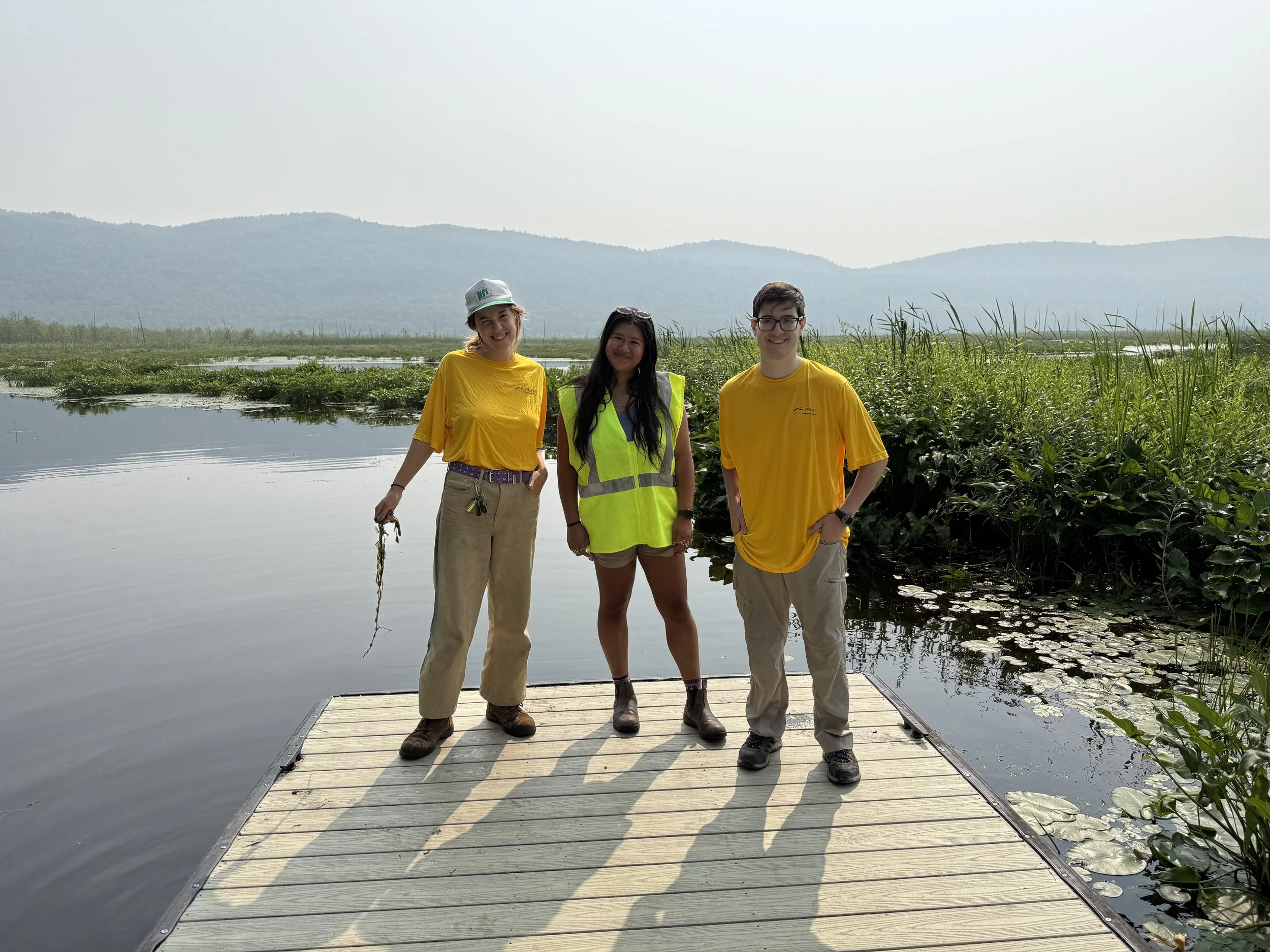
LCA’s Boat Launch Steward Coordinator and Stewards, Olivia Welford, Nina De Silva, and Ryan D’Alleva pose for a photo on a beautiful July morning in the summer of 2025 at Bristol Pond. Photo credit: Kate Kelly
August 31st marked the end of Lewis Creek Association’s (LCA’s) sixth boat launch steward program season at Bristol and Monkton Ponds. The two ponds saw many visitors throughout the summer months, from anglers to recreational boaters to wildlife enthusiasts, making them ideal locations to educate the public about aquatic invasive species (AIS). As of 2025, there are three known AIS in Bristol Pond: European Frogbit (Hydrocharis morsus-ranae), Eurasian Watermilfoil (Myriophyllum spicatum), and Brittle Naiad (Najas minor) (discovered by the boat launch stewards in 2021 at Bristol Pond); there are four known AIS in Monkton Pond: Eurasian Watermilfoil (Myriophyllum spicatum), Curly-leaf Pondweed (Potamogeton crispus L.), Chinese Mystery Snail (Cipangopaludina chinensis), and Banded Mystery Snail (Viviparus georgianus). Presence of these AIS in these popular ponds means that they could function as points of introduction for the spread of AIS in the Lewis Creek watershed and throughout the state. The goal of LCA’s boat launch steward program is to prevent the spread of AIS by: inspecting watercraft for AIS and other biological materials, identifying and removing suspicious specimens, performing early detection of new invasives, collecting data, and educating the public about AIS spread prevention.
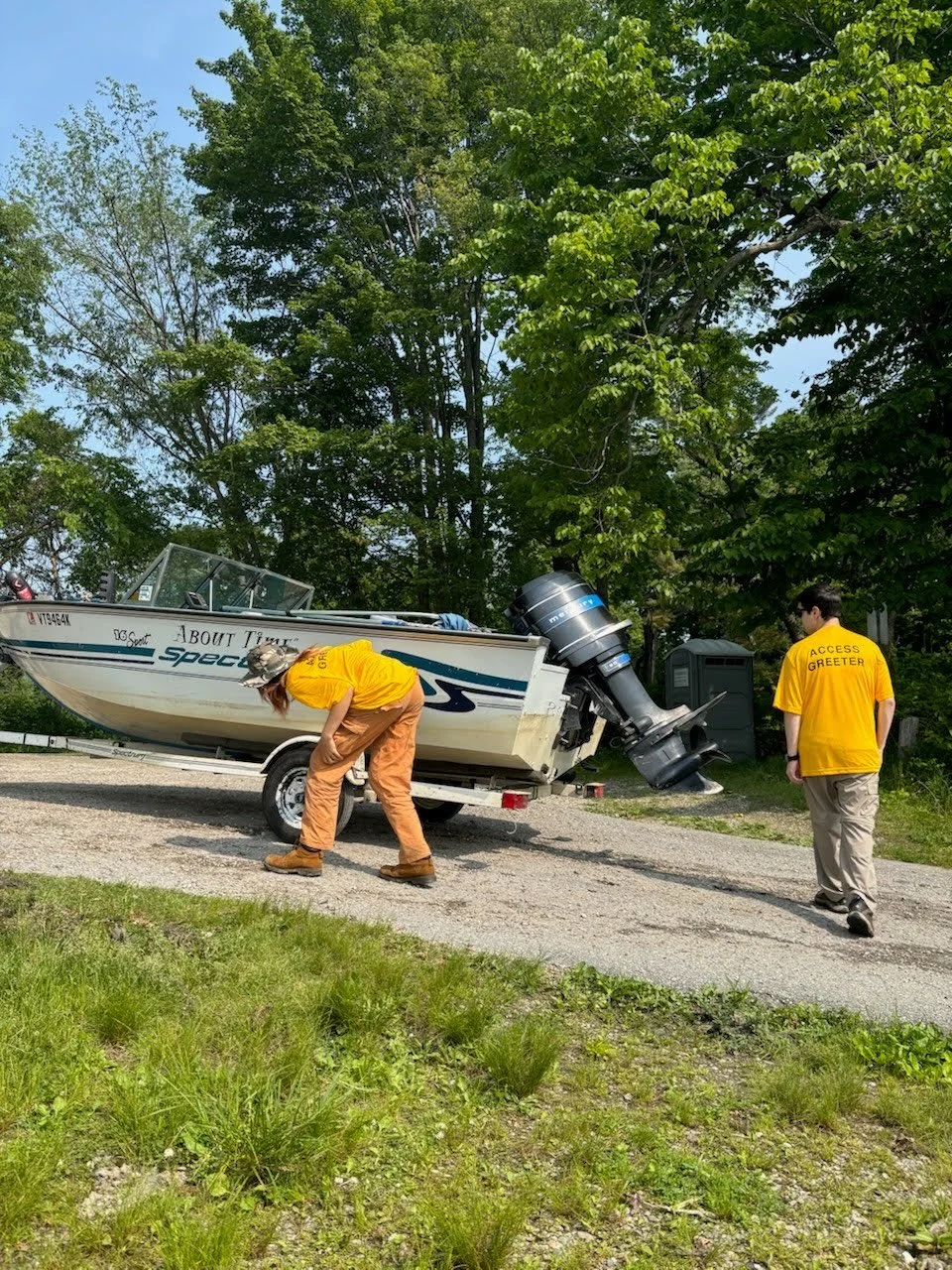
Boat launch stewards conduct an inspection of a watercraft before launching. Photo credit: Nina De Silva
Though the start of the season saw wet weather, the summer was extraordinarily dry and Vermont was in a drought starting August 10th. The water level began to drop mid-summer and continued to drop into the fall. The low water level made it more difficult for boaters to sail through the thick swaths of Eurasian Watermilfoil and other plants. In 2025, LCA’s boat launch stewards interacted with a total of 379 watercraft at Bristol Pond and 130 watercraft at Monkton Pond. The vast majority of visitors were already familiar with AIS, likely due to the longevity of the LCA boat launch steward program and repeated instances of stewards across the state educating the public about AIS concerns. However, LCA’s stewards still intercepted 107 watercraft with aquatic plants on them before entering and/or after leaving Bristol and Monkton Ponds. If the AIS were not removed by the stewards, these watercraft could have introduced AIS to new waterbodies throughout the state and beyond. The stewards also helped remove Brittle Naiad near the dock at Bristol Pond during their free time between greeting visitors.
For the sixth summer, LCA’s boat launch steward program was successful in intercepting AIS and educating the public on the issues surrounding AIS. The vast majority of visitors to Bristol Pond and Monkton Pond seemed genuinely excited to have the program at the ponds. Research has shown that visual inspection and hand removal of aquatic vegetation is extremely effective at preventing AIS from spreading to other bodies of water, making LCA’s boat launch steward program integral to maintaining the health of waterbodies within the Lewis Creek watershed and beyond. Pending funding, we hope to continue the program again in summer 2026.
In addition to staffing the ponds on the weekends, the stewards also worked as technicians removing Japanese knotweed at two demonstration areas along Lewis Creek: Ferrisburgh in the second year of treatment, and Starksboro (Cota Field) in the first year of treatment. Japanese knotweed is a particularly tough plant to remove; it spreads primarily by its roots/rhizomes, which can break off during a flood then resprout and form a new colony downstream. The two technicians, supervised by consultant Michael Bald of Got Weeds?, implemented non-chemical control work (repeatedly cutting the stems flush to the ground, thereby depleting the roots of energy) at the two demonstration sites, with the help of four volunteers. As expected, work at the Ferrisburgh site in 2025 produced measurably less volume removed than in 2024 (60 cubic feet vs 138 cubic feet) while still requiring 16 regular visits. Approximately 82 cubic feet of knotweed were removed from the Starksboro site at Cota Field over the 19 visits. LCA staff and consultant also held a knotweed removal demonstration event in August 2025, which was recorded and can be viewed on LCA’s YouTube channel. This first video (https://bit.ly/knotweed-1) describes the project background and our work and plans for removing Japanese knotweed at both knotweed removal demonstration sites, and the second video (https://bit.ly/knotweed-2) visits both removal sites to demonstrate knotweed removal techniques, shows our knotweed drying stations, and answers community members’ questions.
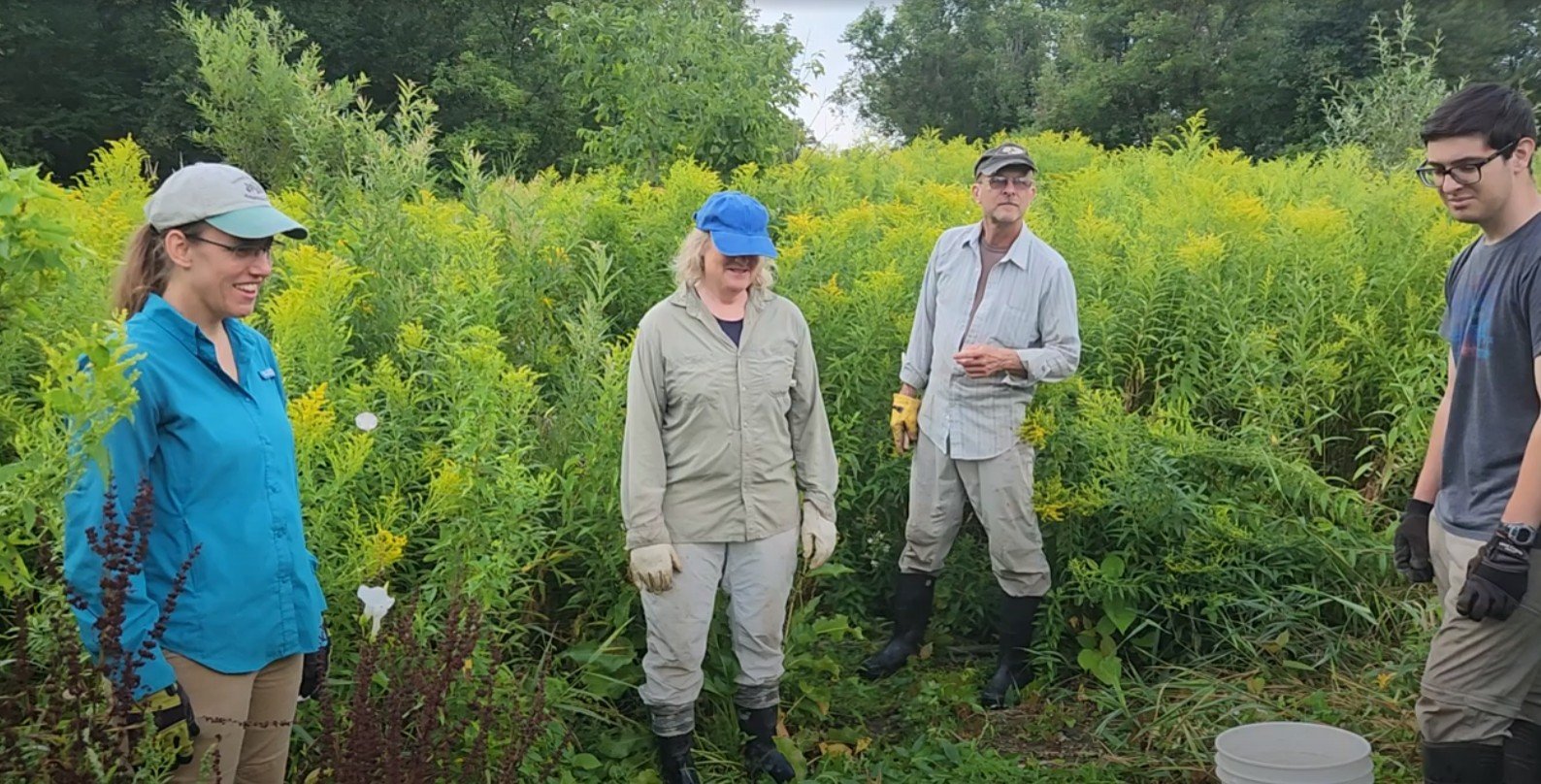
Participants attending the knotweed removal demonstration event at the Starksboro Cota Field site with Mike Bald, LCA staff, and knotweed removal technicians on August 13, 2025. Photo credit: Sara Lovitz
In 2026, the LCA team plans to expand the program to address three sites (Ferrisburgh in the third year of management, Starksboro sites at Cota Field in the second year of management, and at Common Ground Center in the first year of management). Everyone is invited to help if they wish! LCA is partnering with Mike Bald (Got Weeds?) to guide this work and demonstrate effective methods for knotweed removal without herbicides. LCA will also be continuing our iNaturalist project and we need your help, as we know there are many knotweed patches that haven’t yet been mapped! If you see knotweed growing in the Lewis Creek watershed, please snap a photo and upload it to iNaturalist; find more detailed directions and knotweed identification materials on our website. And please join our mailing list, so you know when our knotweed removal demonstration day(s) will be held in 2026. You can learn more and sign up at https://bit.ly/knotweed-project
This product has been funded wholly or in part by the United States Environmental Protection Agency under Assistance Agreements (LC00A01526 and NA23NOS4690078) to NEIWPCC in partnership with the Lake Champlain Basin Program.
