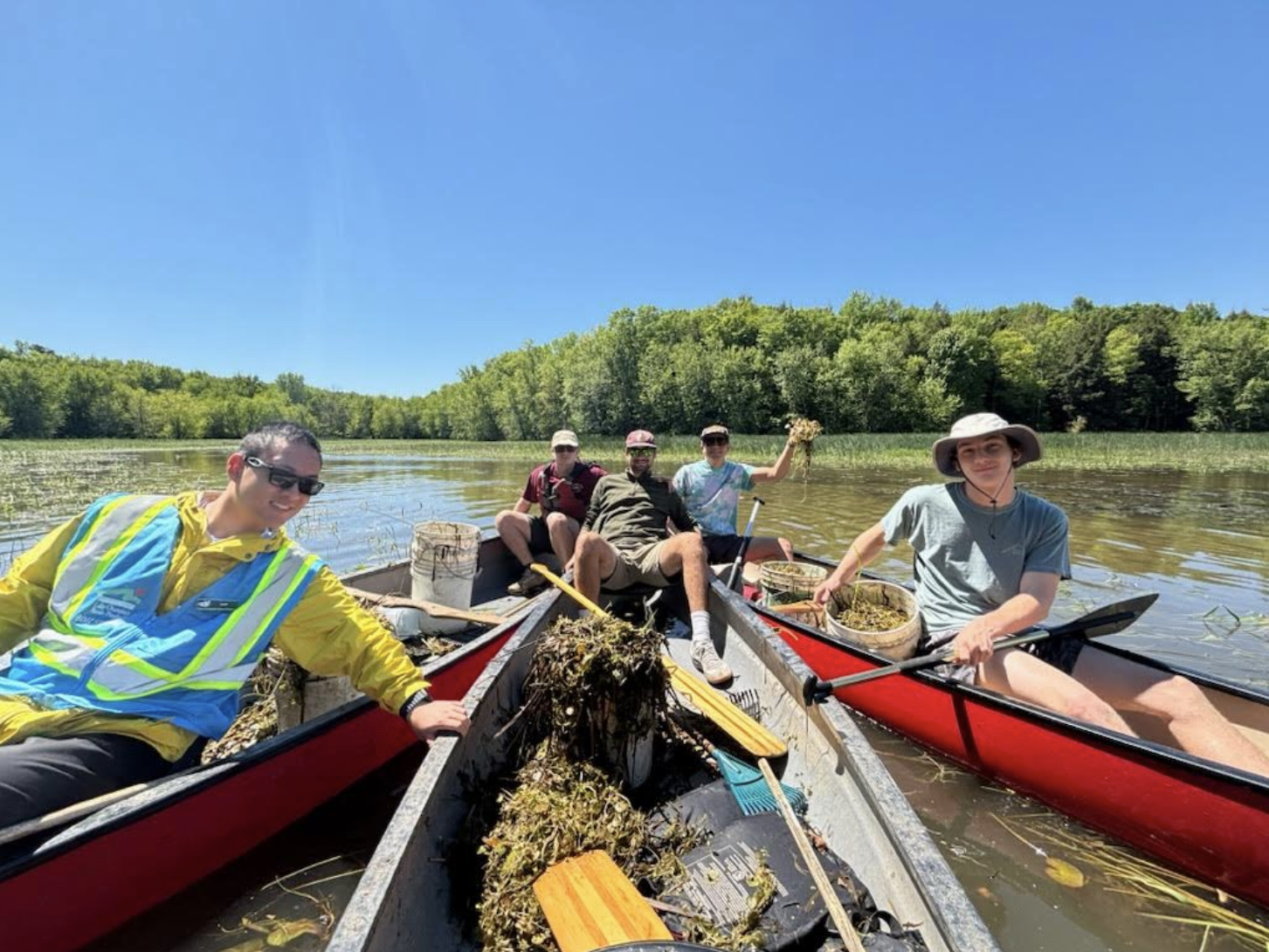
Lake Champlain Basin Program Boat Stewards with canoes full of frogbit on June 3, 2026 in Town Farm Bay, Charlotte. Photo credit: Nina DeSilva
Have you heard about all the non-native invasive species in Lake Champlain? These include 51 species of plants, animals, and pathogens that were introduced to the Lake Champlain Basin. Some were planted because they had pretty flowers. Others got here through ballast or bilge water from boats. These non-native species (species that were not present at the time of European settlement) can, in some cases, spread and take over (becoming invasive) because they have no natural predators. Just over a dozen species are currently considered invasive in Lake Champlain, including plants like water chestnut, European frogbit, and Eurasian watermilfoil, which can grow so thickly that they make it difficult or impossible to boat, swim, or fish. This can also cause a major problem for our native plants and animals in ecologically rich natural areas, who get choked out by these intruders. Some of the aquatic invasive species like zebra mussels can be difficult to control, while others, like European frogbit, are more easily removed to limit their spread.
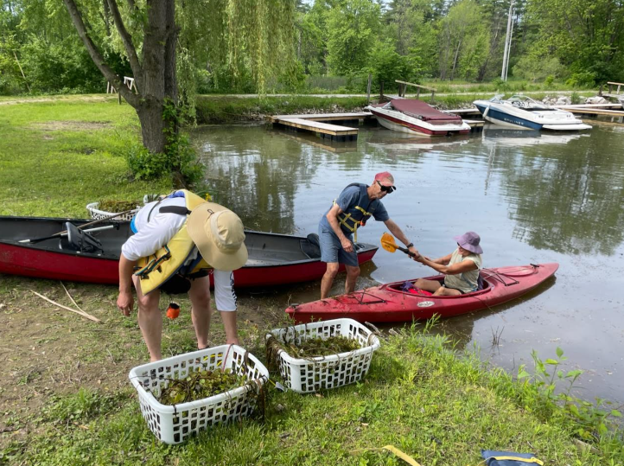
Volunteers unloading laundry baskets full of frogbit they removed from the Lower LaPlatte River on June 5, 2026. Photo credit: Olivia Welford
Lewis Creek Association (LCA) has been working closely with the Vermont Department of Environmental Conservation and the Lake Champlain Basin Program since 2009 to monitor and remove European frogbit, water chestnut, yellow iris, and flowering rush in Town Farm Bay in Charlotte, and the LaPlatte River Natural Area in Shelburne. These two areas are very diverse ecologically, and many people recreate there, making control of non-native invasive species critical and enjoyable!
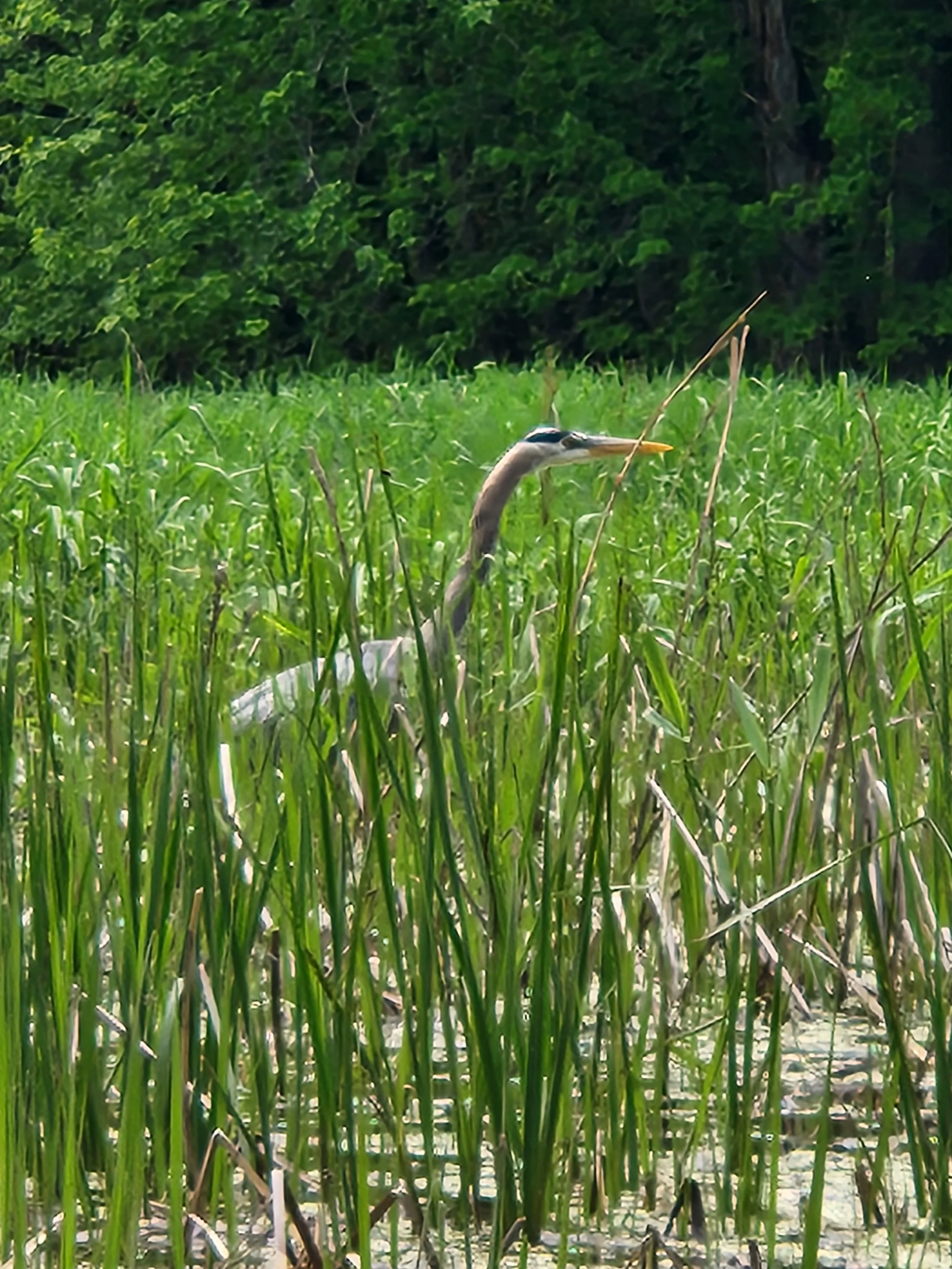
Great Blue Heron seen on the Lower LaPlatte River in Shelburne on May 27, 2026. Photo credit: Sara Lovitz
Frogbit removal efforts in Town Farm Bay began in 2009, when approximately 50% of the wetland in Town Farm Bay was covered in frogbit. Since 2011 in Town Farm Bay and 2012 in the LaPlatte River Natural Area, LCA volunteers help rake frogbit off the surface of the water each summer to maintain a small population, resulting in an annual percent cover of less than 5%. Though frogbit will never be eradicated in either location, maintaining this low population allows native plants and animals to thrive. Together with volunteers, we have removed 33.1 tons (66,224 lbs) of frogbit from Town Farm Bay and 8.9 tons (17,813 lbs) from the LaPlatte River Natural Area, through the end of 2025.
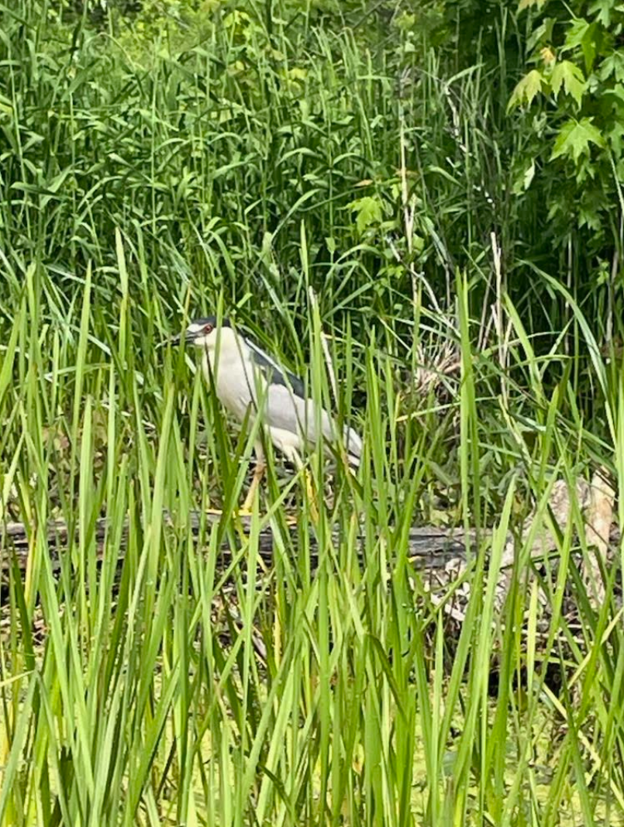
Black-crowned Night Heron seen on the Lower LaPlatte River in Shelburne while removing frogbit on June 5, 2026. Photo credit: Olivia Welford
Our frogbit removal volunteer program continues to run annually in June and July at both locations - sign up at bit.ly/frogbit2026. Please check back as more dates are added throughout the season.
All gear, including boat, paddle, lifejacket, rake, and bucket/basket are provided! These trips are great fun – all you have to do is show up and be able to paddle in a canoe or kayak, raking plants off the water surface, and putting them into a bucket or laundry basket on your boat. While you’re helping you can enjoy the many species of birds and other wildlife on the water. So don’t delay, grab a friend or two, and sign up today at bit.ly/frogbit2026
For more information or to join our frogbit removal volunteer list, contact Sara Lovitz (LCA Watershed Program Assistant) at sara@lewiscreek.org or 488-5295.
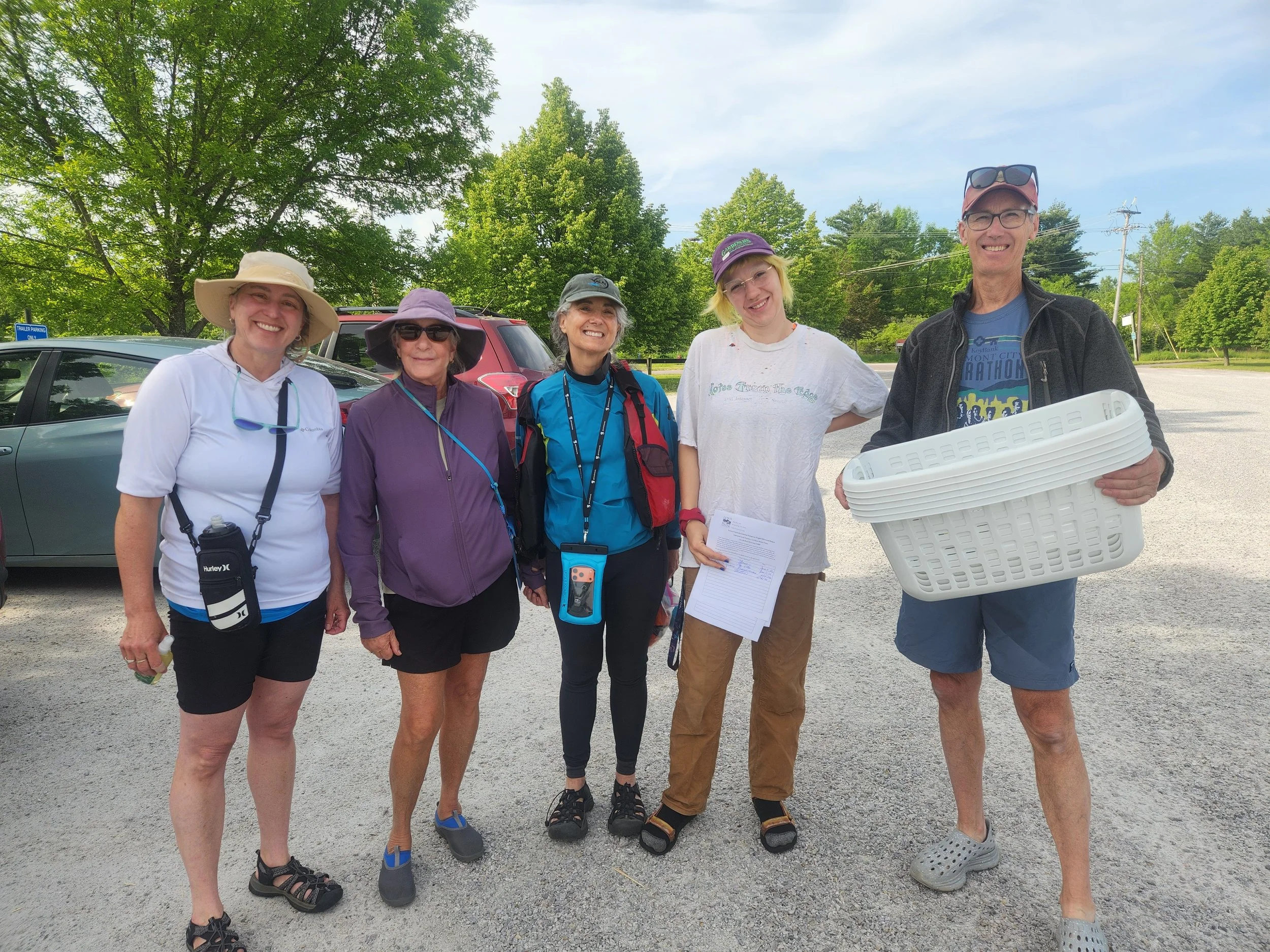
LCA volunteers ready to head out on the first frogbit removal trip of the season on the Lower LaPlatte River on June 5, 2026. Photo credit: Sara Lovitz